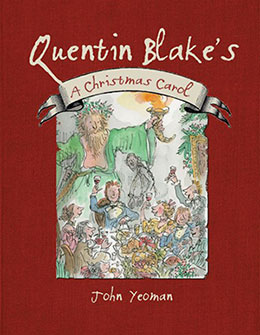
 I have no idea when I first read A Christmas Carol. Perhaps it was read to me. I might have heard it on the radio, if you can believe in such ancient times. Many times I have seen the British film, in black and white, with actor Alastair Sim who played Scrooge quite wonderfully. I took my kids to see stage adaptations of the book. I have read the book to my wife any number of times. Indeed, it has been said that the best way to enjoy the book is to read it out loud. I’ll do so this Christmas eve.
Dickens wrote the book quickly, apparently within a six-week period in 1843 even as he was working on a much larger serial novel, Martin Chuzzlewit, not, in my view, one of his better efforts. As he wrote A Christmas Carol in a frenzy, he described himself alternating between crying and laughing aloud. Still, the first draft was not perfect. The original manuscript is in the Morgan Library and Museum (NYC) and, yes, I have looked at it when it’s been put on display there. Here, look at it for yourself.
When visiting classes, I used to show kids pages from this MS by way of demonstrating that even a writer of genius revises his or her work.
But I note that the opening words, “Marley was dead: to begin with,” was not altered, and I think of that sentence as one of great brilliance.
I think the writing throughout is quite wonderful, so deep and incise in delineating character and place, while swerving madly — like a racecar driver on a twisty course — from humor to pathos.
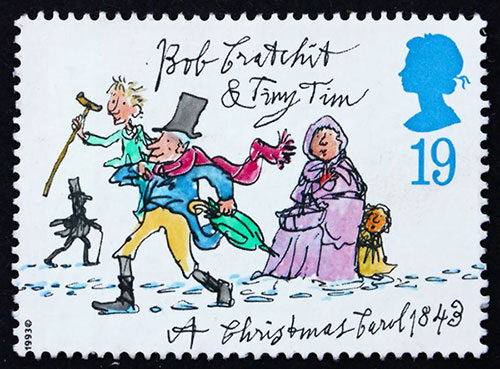
featuring an illustration by Quentin Blake
for Charles Dickens’ A Christmas Carol. Find the link to
The Postal Museum in London at the end of this article to learn more.
2 thoughts on “Re-reading <em>A Christmas Carol</em>”
Happy Christmas to you and yours, Avi. May 2026 bring joy and success in all you do. Best, Edie Pagliasotti
HAPPY BIRTHDAY TO YOU!
HAPPY AND HEALTHY NEW YEAR TO ALL!
Barbara Senenman