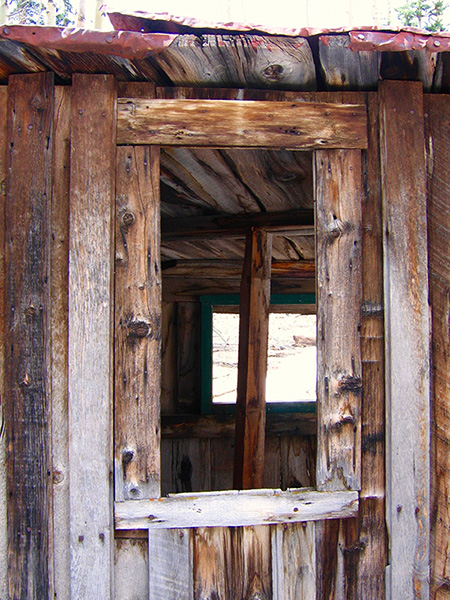
(When my wife and I first drove to the area — about twenty-five years ago — we observed an ancient, collapsed log cabin a mile off the road. Probably a prospector’s cabin. Over it hung a triple rainbow—surely a good omen. These days, as we drive by, we never fail to note it.)
At some point, I began to think of the basic question which evolved into this book: What was it like for a kid to grow up in one of those isolated 19th-century mining communities?
Then I search for memoirs, histories — a lot of reading — and even talk to local folks who know the history of the area, since Colorado is full of such ghost towns.
When I finally begin writing, I have only a general sense of what the story is, but I let my intuition guide me. As I endlessly rewrite, the story takes shape. Same for the characters. When it becomes whole — usually a year’s work — I read it to my wife and then find a class to whom I read it aloud.
More changes.
At one point, I shared the book with a good friend — the late, great writer, Will Hobbs. He knew old Colorado much better than I did, read the manuscript, and set me right in a couple of ways.
Then the book went to my agent, who placed it with an editor.
That acceptance by an editor was a huge step forward.
In this case, since it was a new editor, we had a meeting in which we talked at length about the book, its strength, its weaknesses, and the kind of changes, expansion and contractions that happen with every book. It helps to have a smart, articulate editor.
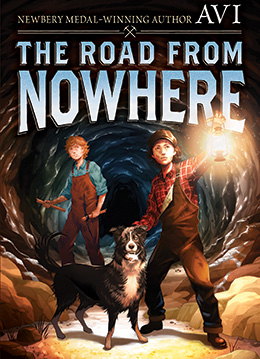
More rewriting, more conversations with the editor, more back and forth as the book took its final shape. Even the original working title, Chasing Rocks, went through a few changes until it became The Road from Nowhere.
Cover art was discussed, and I offered (I don’t always) a general idea. I saw a sketch of the cover, and in this case, suggested that one of the boys depicted turn to look in a different direction, for greater focus. That idea was agreed upon, and I got to see the final art. What I didn’t see was the lettering on the cover.
Now I think of a book — any book — as an art object, which can be very beautiful or ugly. Or something between. I’ve had them all.
I share all this because when I finally saw the actual printed, bound book, I was fascinated by its feel, its heft, its look. Sure, as the cliché has it, you can’t know a book by its cover. But a good cover brings readers to a book. A printed book — even in this computer age — does not look like the manuscript on my computer.
It’s different. It’s new.
What font did the publisher choose to print the text? What is the layout, the design of the page? What is the quality of the paper? Bright? Dull? Was it well-bound? Pages glued together or stitched? If the book has illustrations, how do they look? Where and how are they placed? What impact do they add to the text?
All of these things I am seeing for the first time and are of great interest.
I do not sit down and read the book. I’m afraid I’ll find glitches or places I could have improved. Anyway, it’s too late.
(But once, when a new book came to me, I discovered that ten pages had been left out!)
Finally, I have a ritual. I sign my name on the title page, note the date on which it was received, and place it (chronologically) with my other books.
So, is it kind of ordinary to have a new book published?
Anything but.
Except — I usually have one final thought: How did I ever manage to write it?
Because, you see, I am already working on something new, and it is rather a struggle.
Will it ever be done? Will it ever be published?
The truth is, in all of this, I’m never certain.