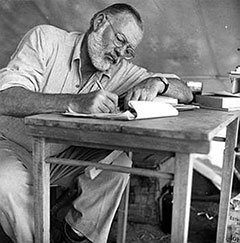
 There is an old Ernest Hemingway story that goes something like this. In 1922, the young writer was in Switzerland, skiing. Back home, in Paris, was his wife, Hadley, along with the manuscript of his first novel, as yet unpublished. Hemingway wrote to his wife and asked that she join him, and please, bring along that manuscript.
She came by train, putting the manuscript in a suitcase. At some point along the way, that suitcase was lost, along with the novel.
It was never found.
There is an adage among writers that any writing that is lost is inevitably the best thing that you have written.
In the age of computer writing, it is very easy to lose your text. Computer confusion. Power outages. Inadvertently flicking the wrong key. I’ve experienced it all.
That said, I’m not sure that I have been inspired by the Hemingway story, but I am constantly saving my work. In fact, I save it to a couple of computer files. I even have a backup battery because if the power goes out, that battery will protect anything I have written. Living, as I do, in the rural mountains of Colorado, power outages are all too common.
Now then … hang on.
Years ago — maybe twenty years — I wrote a novel — let it be said — a creepy novel. I submitted it to my editor — editor A — who had some good things to say about it, but not enough to publish. “Too creepy,” was his verdict. Agreeing with him, I put it away.
Some seven years later, quite out of the blue, that same editor (editor A) told me he had been thinking about the book. “Maybe we should publish it now.”
All well and good, but where is the text? I had composed the text on a computer that used those small rigid disks — rigid, but called “floppy” disks. Over the intervening years, I had moved. In the process, I threw out lots of junk. Where — if anywhere — were those old floppy disks? Did I have that particular one?
Had I lost that novel?
It took a lot of searching, but I found a shoebox full of floppy disks tucked away in the corner of my new basement. And yes, there was the floppy disc with that manuscript.
BUT — I had upgraded my computer, and the new operating system no longer used floppy disks.
I tracked down a technician who had the tools to convert that old disk into a modern computer format. I resurrected the text of the novel, saved it, printed it, and commenced working on it again.
That all took a couple of years.
But alas, by the time I felt it was ready to show the revived book to editor A, he had passed away.
I put the book away, but a couple of years later, I dug it out and worked on it some more.
I shared it with a couple of trusted readers. No one liked it. Too creepy.
Once again, I put it away.
Stay with me. I shall come back to that creepy novel.