The proverb, “You can’t tell a book by its cover,” seems to have obscure origins, which cannot be traced to a particular person or moment. Since the phase gained currency in the mid-19th century, it probably can be associated with the public’s growing literacy and book reading.
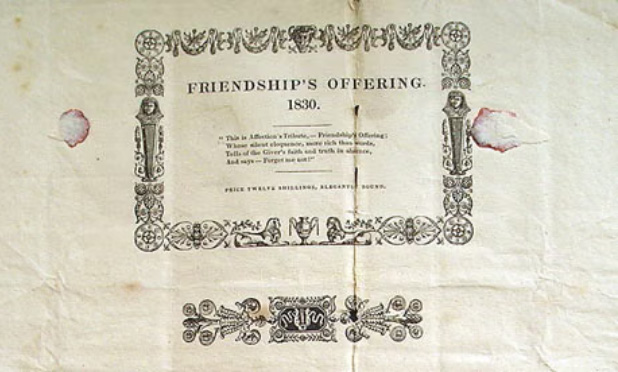
Just recently, England’s Oxford University’s Bodleian Library (one of the world’s great libraries) announced that it had found the earliest known dust jacket, which covered an obscure 1830 gift book titled Friendship’s Offering.
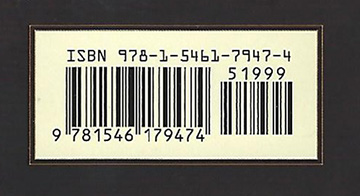
Today, book jackets are ubiquitous. They have a fairly traditional format: Title, author, a summary of the book’s content, biographical information about the author, publisher, praise-worthy remarks about the book, a barcode for selling purposes, price of book, and the book’s ISBN number.
That ISBN number stands for “International Standard Book Number.” Each published book has a unique number. According to ChatGPT, these days, there are always 13 numbers. Apparently (nothing I knew), each part of the sequence has a purpose:
- Prefix (usually 978 or 979): shows it’s an ISBN
- Registration group: identifies the country or language area
- Registrant: identifies the publisher
- Publication: identifies the specific title and edition
- The final number is meant to verify that the ISBN is valid
The dust jacket we know today came into use in the 1850s and by the 1890s became universal. Originally, the binding of books was decorated, but by the 1920s, the art had migrated to a paper jacket. For book collectors, having a first edition of a book with a pristine original jacket can radically enhance its dollar value. The first edition of The Great Gatsby can be worth as much as a $1,000. Not so long ago, the book, with a mint condition dust jacket, was on sale for $500,000.00.
(Considering such valuations, it should come as no surprise that there are book jacket forgeries!)
The jacket design creation is a complex process. Unless it is part of the author’s contract — a rarity — the author of a book is given no more than a right to comment on the jacket’s design and art. In my early days of publishing, I wasn’t given that. These days I am welcome to react, though that is no guarantee that my reaction is noted.
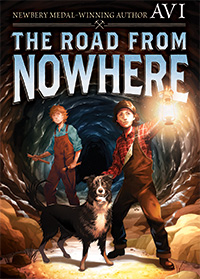
It is the book’s editor, art director, book designer, and artist who create the dust jacket. Let it be said, I think my most recent book, The Road From Nowhere, has an excellent cover. Insofar as it suggests the action in the book it’s known as a “narrative cover,” that is, it portrays some action in the story.
I was shown an early sketch of the cover and one of the boys was looking in a different direction. I suggested that it fudged the focus of the image. It was changed.
As the selling of books came to the internet, a publisher told me book covers had to be designed so the smallness of covers would be still recognizable on the screen.
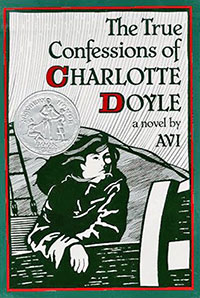
Then too, a popular book, with a variety of publications over a number of years will have many different covers. There are multiple editions of my True Confessions of Charlotte Doyle, both domestic and foreign, hardback and paper. Each one has a different cover. My favorite is still the original Orchard edition.
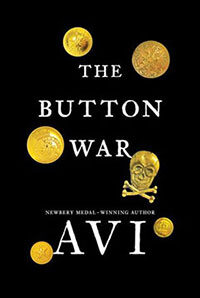
My The Button War tells a World War I story about boys who collect (amidst the war) soldiers’ uniform buttons. As I wrote the book, I began to seek out such buttons. (In so doing I discovered the world of button collectors.) At my suggestion, the cover of the book has images of the buttons I collected.
In the days when I went to University (the 1950s), the Modern Library, which published huge series of classic books, listed all the books in its collection on the underside of its jacket. I would consult this list as I pursued my own reading.
Sometimes, a popular author with multiple books will have redesigned covers so that all the books look the same, that they may be recognized as being from the same author.
The key point is that, beyond all else, dust jackets constitute the first marketing of a book, the point when a potential reader (borrower or purchaser) encounters the book. I have had poor jackets and fine ones. It can make a difference because, yes, people do select books by their covers.
Don’t you?


