When I write one of my books, for many years, I compose and rewrite directly on my computer. This computer is a PC with a fairly large screen. I also have a keyboard that I chose because the keys move a good bit and make a rather loud clack when I press any one of its keys. (It happily reminds me of my old manual typewriters.) I do own a laptop, but honestly, I dislike it and use it only when I am traveling. The screen is small, and the keys are silent. But at least I get my work done.
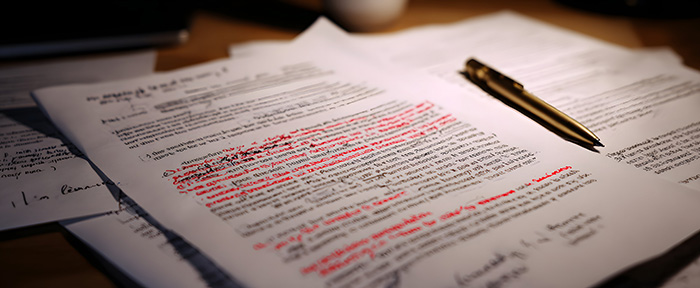
At a certain point, when I am writing, I feel the need to print out my work. It appears I see the printed page differently than text on a screen. I make more and better revisions on the printed page than I do on a screen.
One source I researched said, “Screens are excellent for quick references, search, and short texts. Printed pages are often better for deep, sustained reading and comprehension.”
Indeed, there is, apparently, such a thing as “screen inferiority effect.” On a screen, one “understands slightly less, remembers fewer details, and has more difficulty with complex ideas.”
I also think — speaking for myself — the printed page text has a greater affinity with a printed book, which is what I am trying to create. I truly love reading books, love the physicality of them. I want to create books, not pages. I think I read books more critically (in a positive sense) on paper than on screens. That is — for me — the printed page feels more like a book I read, and I judge it more like an actual book.
It must be said, as a factor of age, I learned to read with physical books. I would be curious to know if there is any research that shows different reading habits acquired by those who learn to read on a screen.
(I can recall feeling bad for the fellow who once told me he had no need for a library of books. Instead, he said, “I keep all my books on my Kindle.”)
There is another way that enables me to see flaws in my texts and make revisions. When I write I am always listening (in my head) to what I am writing. But then I go on to read my work aloud, which I always do from a printed text. In my writing process, reading the text of a new book — to my wife — is always a crucial step forward.
Yes, she is an excellent (and necessary) critic of my work, but when I read my work I also become a better critic.
Reading aloud forces me to consider every word I’ve written and say it. When I do so it is less my critical faculties that are making judgements, as it is my ear. I can hear when the rhythm of my work is off, or catch when a particular phrase makes no sense, when word repetitions have crept in, and even when I am repeating myself. It is as if — when reading aloud — my story telling goes back to its original format, me telling you a story. Which is to say I trust my ear more than my eye.
Perhaps it is as Stephen King once said, “When someone reads a text aloud, the listener must move at the narrator’s pace and therefore absorbs more detail and nuance in the language. “
In conclusion, I am tempted to say,
let’s hear it for good writing.
3 thoughts on “On Paper”
There is an article in Scientific American March 2013. I kept it because it talked specifically about reading from a screen vs a page with something written or typed. The brain views the screen differently than a page therefore retention and comprehension are lower. Why? Because the screen is perceived as an illusion by the brain while words on an actual page are perceived as “real”. It was an interesting article that states many other facts that are a bit alarming and this was over a decade ago!
Your writing process is similar to mine except that I actually start out on paper and then when the direction becomes “more solid” I move it into the computer. So imagine me guarding the several notebooks of on ongoing project. It never really is far from my physical person. And in early development any scrap of paper will do. All these are kept. My husband has now learned that if the back of an envelope or even the margin of a newspaper has my writing on it, it can’t be thrown without my permission:). Of course, I am older but I find that my brain works better on paper—
Always inspiring advice. Today, I’m going to my library to print out my children’s novel to read aloud and edit based on my critique partner’s suggestions as I see are warranted.
Doing the same thing today.