I’m about to start on a new book.
I won’t chat about what it’s about because I have long believed that talking prematurely about a project depletes the energy I need to write it. Then, too, I don’t want to box myself in. I’m a strong believer in that remark by Robert Frost: “No surprise in the writer. No surprise in the reader.” I trust in discovery, indeed, serendipity, as part of my writing process.
That said, there is a regular process by which I will go forward in this new undertaking.
Some books are submitted as a complete first draft to an editor. Sometimes a first chapter. Or more. Or less. Maybe just a shared idea.
(I once went to a movie with my editor, Dick Jackson, and his wife. At some point, he turned to me and said, “You write good dialogue. I’d like to see you write a book with only dialogue.” That was the simple origin of perhaps my most unusual book, “Who Was That Masked Man Anyway?”)
In this current case I submitted a story idea. Thus, right from the beginning there have been discussions with the editor about the book, but only in a most general way.
It needs to be acknowledged that I have a large body of published work, so editors know what I can (and can’t) do. That helps a lot.
Since this new work will be historical fiction, I will begin by assembling a library of books on the subject. For the most part, I use the internet to seek out used books. It is cheaper that way, and I can track down out-of-print books. Indeed, I have often found books that have been discarded by libraries.
I really enjoy building a collection. (I am a former librarian.) One of the ways I select books is, as the books come in, by consulting the bibliographies in the books. It is as if you had many experts guiding you to relevant titles.
Then I begin to read, read, and read some more. Along the way, I will take copious notes, in particular details that can be illuminating of time, place, and persons. I need to develop a sense of how people in this time period thought and acted.
All the while I am thinking about the story I’m going to write, how to begin, how to narrate it. Who are the characters? What are they like? Their back story. What’s my sense of how the story unfolds? First person? Third person? Does it have a particular voice? To what, and how, does the story all lead? What kind of climatic ending shall it have? Much of this is all in my head. And “this” is endless.
In my early days I would try to develop an outline. Now I keep everything in my head so as to achieve maximum flexibility.
Since my story is rooted in a place — a particular environment — I need to plan on travel. When I was working on the Crispin books, a trip to England and a trip to France radically shifted my thinking and writing of two of the books.
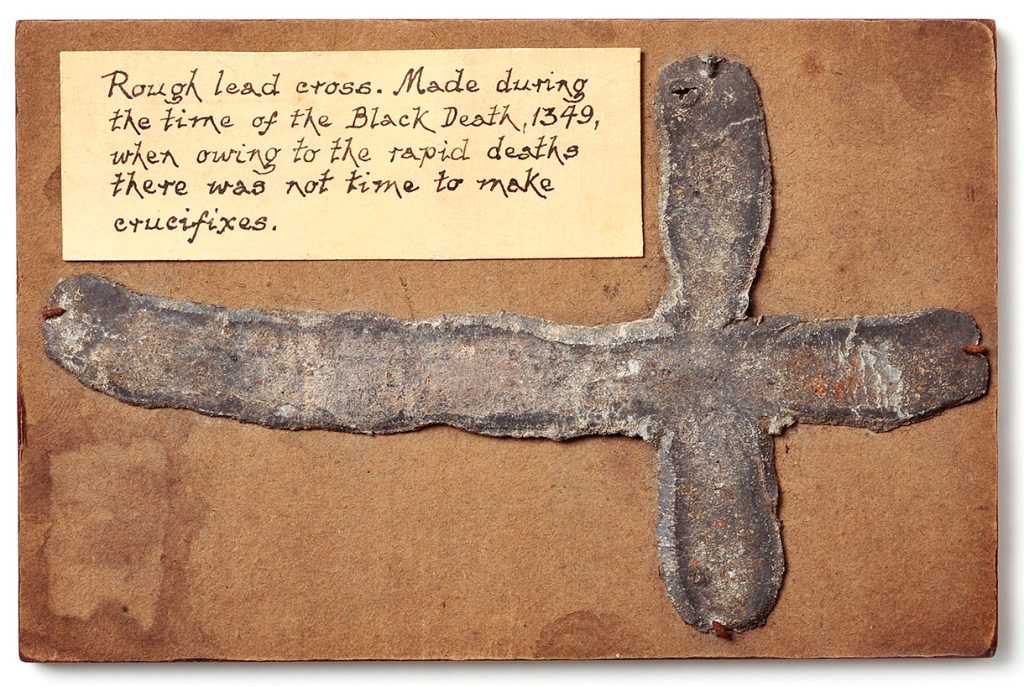
I remember, in particular, a visit to the British Museum, where I unexpectedly came across a display of crude lead crosses distributed during the plague years. (Serendipity!) It may be hard to believe, but in the first draft of Crispin, there was no cross of lead.
When in France, an unplanned stopover (discovery!) in what had been a medieval village shifted the story in a vital way. (And I got to stay in a castle!)
Note that I have yet to do any writing.
Oh, that opening line! Vital. Crucial for the reader but just as much for the writer. Want a simile? It’s like shooting an arrow into the air. Off it goes. What’s its trajectory? How far will it go? Where will it land, because it will land somewhere? I just don’t know when or where.
But I will rewrite that first chapter many times until it feels right.
Then on I go.
You can check back in a year to see how it’s gone. Or still going.
Of course, there is one thing I need to do before all of this takes place: I have to put the finishing touches on the book I have been working on for the past year.
More or less, I went through the same process.
3 thoughts on “Starting a New Book”
What is your current book (Slap!) that you are working on about, and what is this new Historical Fiction book about?
Wishing you great success with the new book, as well as the book you’ve just finished. Best, Edie Pagliasotti
It’s fascinating that you rework your first chapter many times before you go on. I guess once you know how the story starts, I think of it like pulling the bow and getting ready to shoot the arrow, then you’re off.
If you have particular scenes for other parts of your story in your head, do you write those down while you’re thinking about them? Then you’ll figure out where in the story they’ll go? I imagine once your whole draft is complete, you might still rework the first chapter.
What year is this historical fiction set? As I mentioned in a previous post, you could always look at postcards — especially if it’s early 1900’s. Images show what places looked like. Sometimes the writing gives clues to how they speak.
Looking forward to finding out more about your new book.