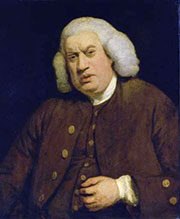
In that regard, I’ve always loved the Boswell/Johnson story: “Mr. Johnson, my friend, has written a wonderful book with brilliant passages, but he cannot find a publisher. What shall he do?”
Johnson: “Tell your friend to remove his brilliant passages, and he will find a publisher.”
I will never write a perfect book. Indeed, I don’t like to read my published books because I know I will find bits and pieces (I’ve had the experience) that I feel I could have made better. But it’s published, so it’s too late.
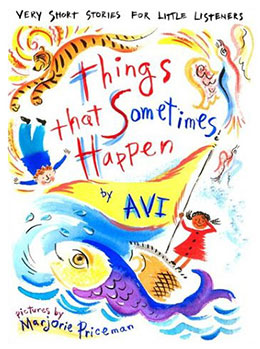
I will never write a perfect book. Indeed, I don’t like to read my published books because I know I will find bits and pieces (I’ve had the experience) that I feel I could have made better. But it’s published, so it’s too late. Actually, there have been a few times when I was given the opportunity to rewrite what was originally published. It occurred when the original book went out of print, and a new editor brought it back in a new edition with better writing. My very first book, Things That Sometimes Happen, enjoyed that happy fate. It’s still in print after fifty-five years.
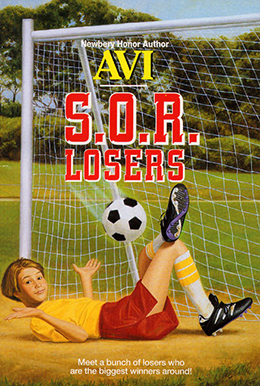
Mind, under normal circumstances, it is the editor who decides when a book is done. That said, a few times I have even had disagreements with editors when I felt the book needed more work, and they believed otherwise. The very first book I did with editor Richard Jackson (S.O.R. Losers) that happened. When he told me — upon receipt of the manuscript — that he thought the book was done, I had the temerity to suggest otherwise “Go ahead,” he said. And I did.
In all the years and books I worked on with him, that never happened again. Indeed, it was he who, more than once, after we agreed a book was done, came up with some fine-tuning, which is why he was such a great editor.
I recall reading a memoir by a writer (I forget who) who claimed that all he wished to achieve was one truly memorable sentence.
My ambitions go beyond that, but I can sympathize with the wish. Which is why when I’m with my readers, and they ask (as they often do), “Which is your own favorite book?” I know the answer. “The one I’m working on.”
“Why?”
I still have time to make it a perfect book.
(Even though it won’t happen.)
1 thought on “In Quest of the Perfect Book”
You made me smile today. My WIP is sitting, lonely, waiting for the next revision after 5 great BETA readers made suggestions…