I’m sure you are familiar with the Merriam-Webster company and its line of dictionaries. It publishes what is considered to be the preeminent dictionary of American English, the one most American publishers use for correct spelling form. Merriam-Webster’s dictionary has evolved from the 1806 A Compendious Dictionary of the English Language, which was the first American English dictionary, as compiled by Noah Webster (1758–1843). In 1783, he also created The American Spelling Book, known as the “Blue-Backed Speller,” which has never been out of print. It was Webster’s hope that he could create standardized American speech and spelling, wanting to distinguish American English from British English.
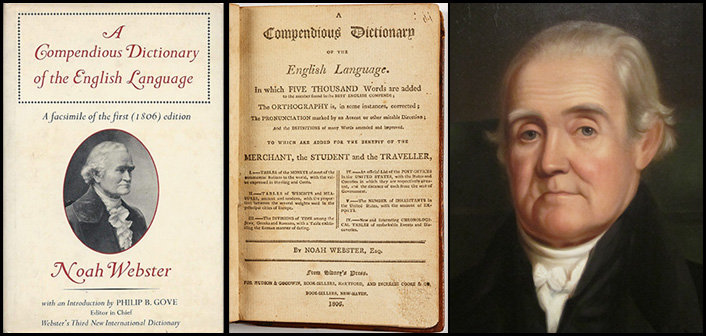
In 1847 (after Webster died), the Merriam brothers took up the company. Today the parent company is (ironically) the Encyclopedia Britannica.
The twelfth edition of the dictionary was published in 2025.
But what I wish to call your attention to today is Merriam-Webster’s free blog, Word Of the Day.
I’m aware that this posting is part of the company’s promotional tools — an advertisement, if you will — but as far as I can see, there is no true commercial aspect to it, other than name recognition.
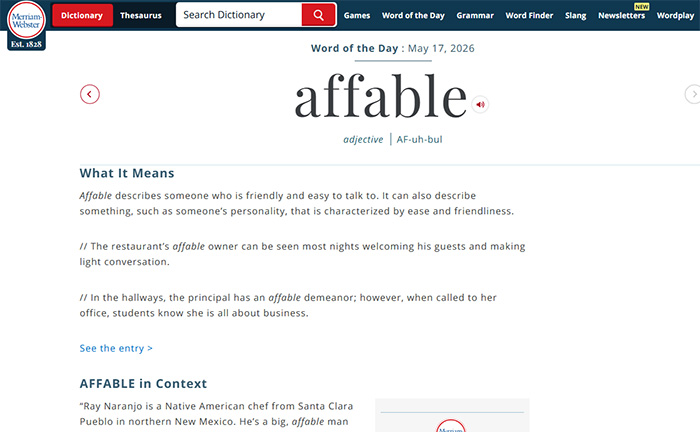
This daily blog is one that this writer finds much in which to delight. There is the “word of the day” (with definition and examples of usage). It’s not often I discover a new word. But now and again I do. And I always love to learn the history of words. In fact, it is the blog’s brief notes about usage that I find most interesting, as it truly impacts my writing.
There was a recent piece about whether using “And” and “But” at the beginning of a sentence is acceptable. Also, the ways of “an” and “a.” “How to Use Em Dashes (—), En Dashes (–) , and Hyphens (-).”
If you know the way of all these things, you are a far better grammarian than I am, which, I confess, is a very low bar. As for spelling, being dysgraphic, there is no bottom bar.
But it’s what I like to talk about to young people when given the opportunity: don’t think of grammar and spelling as rules, but as a better way to communicate. You can say, “I went for a walk with my dog.” But if you spell that last word with the same letters but in a different sequence, “I went for a walk with my god,” it will mean quite another thing. Spelling matters.
The use of words — speaking or writing — is about communication, communication with others. Keep a journal, a diary, and you are talking to yourself, which can be a delightful and helpful exercise. It is, I think, most enjoyable when you read those ruminations after a long period of time. But when you write as I do — as I am doing here — it is to convey an idea, a story, an emotion. I do it with words — and a dictionary is my sidekick.

And just so that you know, ChatGPT says, “The term ‘sidekick’ comes from 19th-century American slang, where ‘kick’ meant a pocket — specifically a pickpocket’s stash or a hidden compartment in clothing. This sense of “kick” shows up in underworld slang of the time. Your “sidekick” was literally the pocket at your side — often where valuables (or stolen goods) were kept.”
So now you know!
2 thoughts on “Word of the Day”
I also get the Word of the Day. I enjoy reading about new words and origins.
By the way, I could read over and over again about how to use em-dash and en-dash and I still use them wrong.
The dictionary and the thesaurus are my sidekicks. Thank you for reminding me of WORD OF THE DAY! I copied fun new words for years and eventually used them (as a trope) in my MG work in progress as the chapter titles. Each new word reflects something in my 13-year-old protagonist’s interior life. He’s a smart writer who is assigned a daily vocabulary journal. It’s a funexercise for me and I’m still working out what chapter words work the best for his family secret mystery. Today’s word DEMEANOR reminds me of a mystery blog called MISSDEMEANORS! Thank you again for inspration! your fan, Beth Schmelzer