
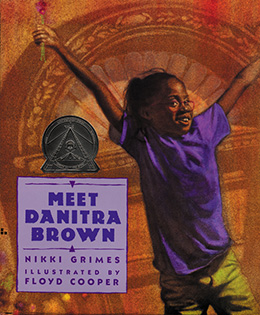
I thought Meet Danitra Brown would be a cinch to write. I was clear on the characters Zuri Jackson and Danitra Brown, I knew exactly what interactions I wanted them to have, and the story I wanted to tell about their special friendship. But when I sat down to write that story, I kept smashing into writer’s block, and I couldn’t figure out why. Then, one day, when feeling especially frustrated, I got the idea to go through my manuscript with a highlighter, and to mark all the passages that were clearly working. Then, looking at the draft with new eyes, I realized all of the good passages were actually poems. Eureka! This book wanted to be a collection of poems! “Okay,” I thought. “I can do that!”
Meet Danitra Brown became my very first story told in poems. I’ve been writing them ever since. In fact, storytelling in verse is what I’m now known for. In order to get there, though, I had to give up the notion that my stories had to be written the way I imagined other authors wrote theirs. Turns out, I had to learn that lesson one more time.
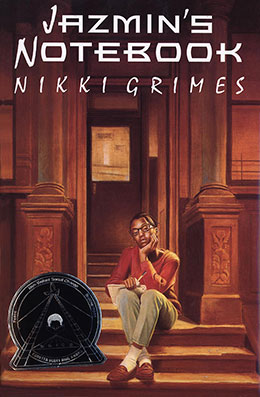
When attempting to craft the novel, Jazmin’s Notebook, I found myself once again with a flat tire on Writer’s Block, going nowhere. I knew my character, I was clear on the plot and the themes of the story, and yet my writing felt like a stutter. I just couldn’t get the words out! This time, I stopped and asked myself two questions: what kinds of books had I been most successful with, thus far? And what genre were they written in? The answer to both questions was poetry. So, why not write this novel as if each chapter were a long poem? I could reformat the chapters later, to have them go all the way across the page, like a traditional prose novel would. Why not? Didn’t the word ‘novel’ mean new? If so, that meant I could write my novel in any style I wanted to, as long as I could make my narrative work as a traditional story, with a clear theme, solid characters, a distinct story arc, and so on. So, I gave it a try, composing each chapter as if it were a long poem, with line breaks and all. After finishing each chapter, I reformatted the words to go all the way across the page, dropping the line breaks and using the same punctuation you’d find in any other novel. And guess what? Suddenly, Writer’s Block was in my rearview mirror!
For 2/3s of the book, I approached the writing this way. At that point, I trusted my process and was able to drop the artifice, give up the line breaks, and simply write across the page, while allowing my poetic sensibilities to guide me.
Jazmin’s Notebook, published in 1998, became the first of my books to win a Coretta Scott King author Honor. Still in print, this book, more than any other, taught me that the only right way to write a book is the way that works for you. Period!
My advice for young writers is to find your voice. Write the way you speak. Read that work out loud to see how well your writing matches your speaking voice. Revise and edit your work accordingly. Be true to yourself. Don’t try to use language the way you think others do. Use language the way you do when you speak. That way, when you write in the first person, or write in dialogue, the writing will sound like you, or like you at the age of the character starring in your story. Why does this matter? Because your voice helps to establish authenticity, and readers respond to characters who seem authentic, using language they are familiar with, that they have heard, that they can relate to. That authentic voice will draw readers in, hold their attention, and make them want to read whatever you have to say because it sounds, and is, authentic.
Don’t try to sound like anyone else, even if that person is your favorite author in all the world. There is only one, authentic you! Be you on the page. No matter how extraordinary your plot may be, if the character feels fake, or unbelievable, readers will not be interested in going on the journey. And that’s what a story is. A journey. Be yourself. That’s the best way to entice the reader to go along for the ride.
1 thought on “2026 Summer Blog Series: Nikki Grimes”
This is great advice, Nikki! I loved reading how you started writing stories in poetic style!