Avi’s Summer Blog Series 2026
Brian Floca
From Avi: Just as we’ve done for the last four summers, 2025 through 2022, I’ve invited 13 admired authors to write for my blog throughout the summer. I hope you’ll tune in each Tuesday to see who answered this year’s question, which we hope provides you and the young people in your life with inspiration. Whether you already read these authors’, poets’, and illustrators’ books or we’re introducing them to you, we trust you’ll find new books to read!
What advice can you give so I can become a writer?
Writing for Me Is Hard Work
A few months ago I received an invitation to submit an essay for Avi’s blog. I was to be one of several authors answering the question, “What piece of advice would you give a young person who wished to become a writer?” I was happy and flattered and I said yes. And since that time, what have I done? I have put off composing my response. The days have ticked by, the sense of guilt and responsibility has ratcheted forward relentlessly, and still I have failed to sit down with pen, pencil, paper, keyboard, stylus, screen, anything. Basically, if you can write with it, I have not picked it up, at least not in service of this good purpose. What is my problem? As a kid I loved writing. (This, long before I dared to imagine I might ever write and publish a bona fide book.) As an adult, I love writing. And so why this delay?
Is it because it is intimidating to write something that will sit next to the work of the other authors writing for Avi’s blog this summer? Surely that is part of the problem. This is a winning humility, or imposter syndrome, or both.
Mainly, though, I think I have delayed because writing for me is hard work. (It was a great relief and insight the first time I heard Avi say it is hard work for him, too, as he does here. Whenever I hear someone say they want to write, I suspect what they really mean is that they want to have written. But I don’t say that writing is hard to discourage you from writing. The opposite, in fact. I say it because I want to share, if you don’t already know it, the idea that it is possible to love something and to do it well and to find it challenging, too. In that spirit, then, here are a few (but not all) of the difficulties I associate with writing, and a few ways of working I have found helpful, too.
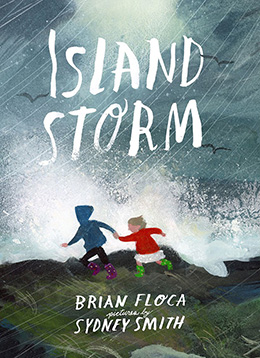 To start at the beginning, there is the perpetual question, “Where do you get your ideas? The answer is, you look for them. In the words of Jack London, “You can’t wait for inspiration. You have to go after it with a club.” The club for me is trying to put myself into interesting places, in contact with interesting things. That might mean reading a book, or visiting a museum, or watching a good movie or documentary — some form of looking, listening, thinking about something I want to know more about. Sometimes I sketch about these things, and if I’m really on my game I take notes, too. I also try to stay in the habit of noticing when I’m noticing something, so to speak, even if I’m not explicitly looking for ideas in that moment. Sometimes you go looking for ideas and sometimes, if you get in the habit of being receptive, the ideas come looking for you. My book Island Storm, for instance, had its beginnings when I found myself in Maine a few summers ago, in the path of strong weather, and realized what an impression the strengthening wind and rain and waves were making on me. It helps if you can cultivate and learn to listen to that voice in your head that says, “You’re interested in something here. You should take notes and figure out what it is.”
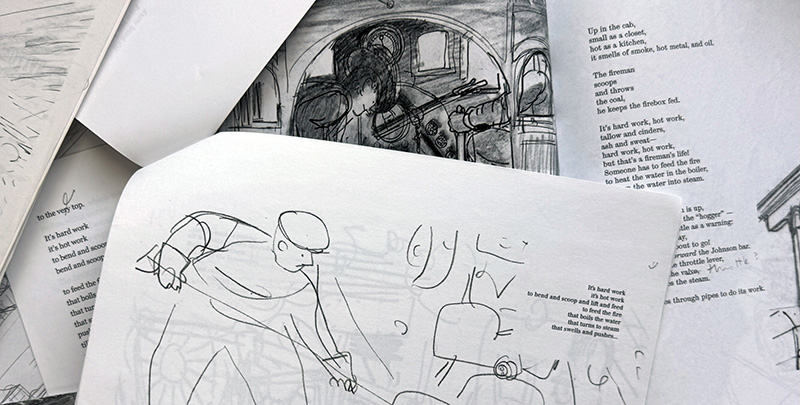
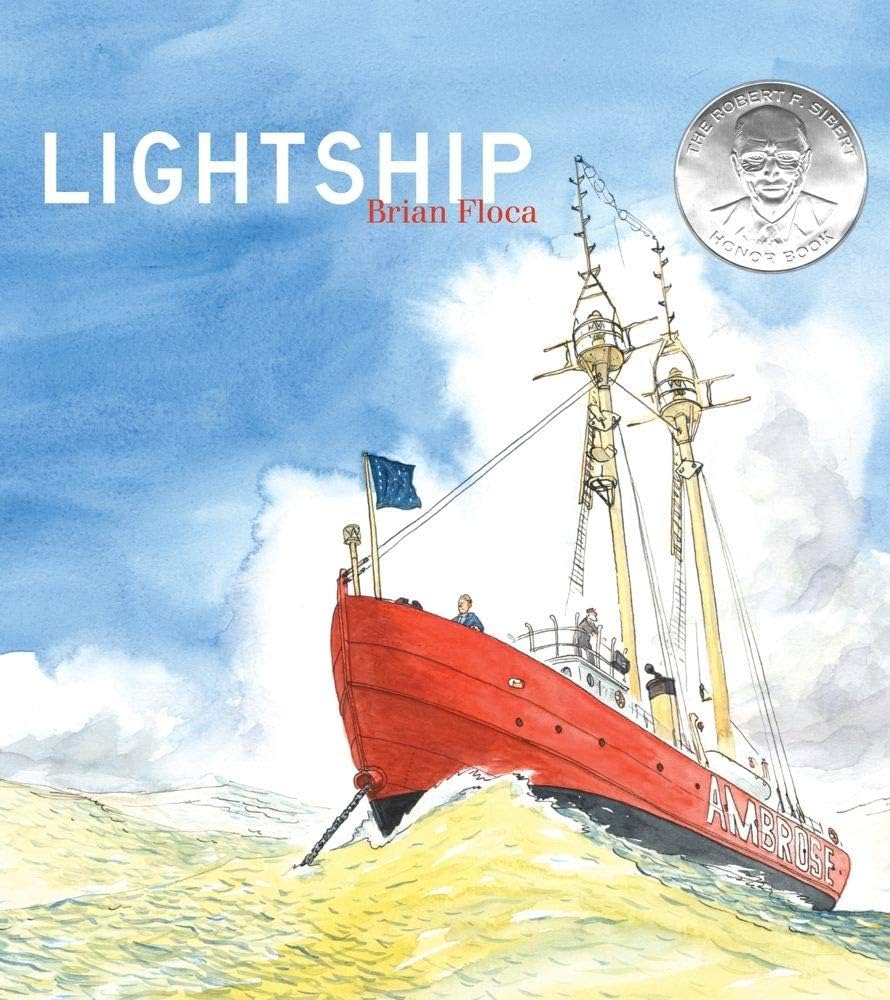
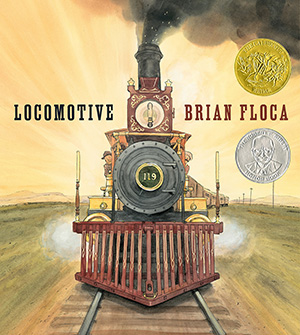
Do I then go home and start writing immediately? Well, maybe and sometimes. But often the process is more indirect. The reading, the looking, the note-taking are all a kind of seed planting. I’m never sure which of these seeds will sprout into ideas for books. 99.9% of them will not, or I would be a much busier author than I am. But sometimes some good thought about something seen months earlier will come floating into my mind when I least expect it — maybe just some single moment that feels like it wants to be part of a story. When that happens (we are switching metaphors now) it is like finding a small piece of solid ground, a little island, and I have learned to pay attention and take action. With my book Lightship the first bit of solid ground was a line that came into my head months after visiting an actual lightship at the South Street Seaport Museum in New York. It came to me early one morning while I was still in bed and half asleep: “Here is a ship that does not sail.” I liked that and knew enough to get out of bed and write that down before I forgot it. With Locomotive it was a line about the fireman’s work that arrived unbidden while I was swimming laps at the Y, of all places: “It’s hard work, it’s hot work, but someone has to feed the fire.” (I remembered that one without getting out of the pool.)
Such small things, these little lines, these little moments, but if they resonate with me I take them seriously and start to look for more. If I can collect a few of these little islands I will start thinking about how they might relate to each other, how I might arrange them, how I might move a reader from one to the other. It’s like setting up an archipelago and a ferry service, too. (Most of these archipelagos sink back into the sea, I should emphasize, but I only need to get one or two set up every now and then to stay busy.)
This is a period of exploration for me. I’m not as a writer trying to give you something I know; I’m trying to figure something out for myself. I may eventually end up with more of these moments than I need, for instance, or moments that don’t seem to agree with each other. Some of those I may need to cut, or not. Contradictions can be an interesting part of a story, adding texture and nuance, or they can keep it from making sense. Deciding which is which is part of the process.
It is not always easy but at the beginning of the process, especially, I try not to worry about getting everything right. I like what John Swartzwelder, a writer for The Simpsons, said about his process in an interview with The New Yorker: “I always write my scripts all the way through as fast as I can, the first day, if possible … Then the next day, when I get up, the script’s been written. It’s lousy, but it’s a script. The hard part is done … All I have to do from that point on is fix it.” In other words, fixing your bad writing is easier than writing, so get something written, anything, and then you’re ready to get to work.
And then at some point in that fixing process I recall an interview with the writer Gabriel García Márquez, in which he compared writing to carpentry (we are switching metaphors once more): “Both are full of tricks and techniques. Basically very little magic and a lot of hard word are involved.”
There are those words again, hard work, yes, but what can we do? As Michael Rosen said of hunting bears, “We can’t go over it. We can’t go under it. Oh no! We’ve got to go through it!” On the bright side, worrying about going through the process — worrying about all that fixing, all that carpentry — is always worse than actually going through it, than actually doing it, and indeed it is only by doing it that a true understanding of what you’re writing reveals itself. An instructor of mine at the School of Visual Arts, David Sandlin, used to remind us (used to need to remind us, over and over again), that you don’t make art by figuring out all the possible problems and then solving them and then making the art. Rather, it is in the act of making that you figure out the problems, and solve them, too — or, even better, figure out how to use them.
How to do it? You have to try not to get too loose, or too tight, either. Not too confident, and not too doubting. You have to pay attention to and honor what is exciting you, and also know when to let it go, if it’s some little thing that’s not helping the larger story you want to tell. You wait for the writing to begin to talk back you, and you listen to what it has to say. You try to be honest with yourself about how a line is going to work for you readers, or not, and to let that honesty guide you.
All of this is easier said than done. There are days of frustrations and self-doubt and a lot of revisions and work — but writing is a way of thinking, a way of figuring things out, and in the genuine work of writing and rewriting (and rewriting) you will begin to understand your true priorities and hopes for your writing. And ultimately it is that hard work, and where it takes you, that makes writing rewarding. The difficult days will get you to the good days, and on the good days you will feel the pleasure of sorting, arranging, prioritizing, clarifying, of finding the rhythm and music of the piece, of knowing how to arrange its moments of excitement and its moments of rest and transition, or the pleasure of feeling a word, a thought, a feeling, click into place. And on the very good days there is a joyful and earned sense of active play. The more you do it, the more natural it will feel. Writing is a muscle you can develop.
One other important thing to mention. As I work, if I’m lucky, I’m sharing what I’m writing and all the questions and doubts it is raising with a good editor. I used to think an editor was someone who told you what you couldn’t say and pointed out your trouble with grammar. From my great first editor, Dick Jackson, with whom Avi also worked, I learned that an editor, a good one, is someone who sees what you are trying to say and tries to help you say it. Good editors make good suggestions, to be sure, but even more helpfully than that they ask good questions. You might have a friend kind enough to do something like that for you, to look at your writing and to talk with you, honestly but gently (gently!), about how they think it is working. You won’t have to agree with them, of course, but even if you don’t you will find it helpful to think about why not.
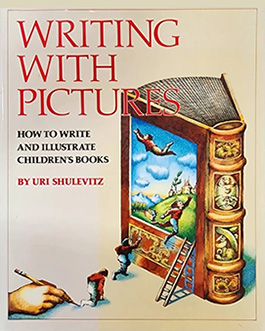
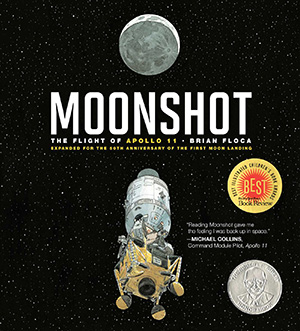
Often the last parts of the story I finish, the parts I am rewriting to the very end, are the beginning and the ending. Back to the archipelago: I want to think about how to get you into it, and then how to get you out of it, hopefully happy that you’ve visited. There should be a sense of entrance and invitation and maybe even provocation at the start. The opening “should shine like a flashlight down through the piece,” said writer John McPhee. About endings Uri Shulevitz writes, in his excellent book Writing with Pictures, “The answers at the end must not frustrate the questions at the beginning. The end must be the direct outcome of the beginning; no substitute answers will do.” And yet some enlargement of the story’s seeming themes and of our understanding should occur between the beginning of the book and the end, too, Shulevitz says: “A good ending should add focus and significance to the unfolding that has preceded.” I have tried for some of this sense of enlargement in my books. Lightship, for instance, begins as a story of a ship and daily processes, but becomes also, I hope, a tribute to duty and helping others (“Other ships sail home safe… because the lightship holds her place.”). In Moonshot what begins as tale of a technological feat and adventure becomes a reflection on our place in the universe. In Locomotive, a trip on a colorful, roaring machine becomes a family reunion. For all its excitement and stimulation, this is the highest and happiest purpose of travel: to get us to the people we love, and who love us, too.
And then how to know when you’re done? Are you ever? I once read of the director Orson Welles (in a review of the book Looking for Citizen Welles, by Michael Woods), “He may have found completing a work difficult…but finishing was also what Welles loved, creating new films in the cutting room and then choosing among them, delighting in fresh differences. “I could work forever on the editing of a film,” [said] Welles…. He was talking about a director’s dream of deferral, the still-alterable movie in which the next cut is always the best.” I often feel that impulse, too, the desire (or compulsion) to try every possible iteration of a book. That is fun and healthy and useful, up to a point. When I begin to feel I’ve passed that point I try to remember the advice a different director, Robert Rossen, would give his actors and crews when he’d gotten the scene he wanted: “It works. It plays. Leave it. Don’t improve it into a disaster.” If only I could truly internalize that one! Eventually I arrive at a place where I realize that even though I might be able to keep making changes to my work, I am no longer able to improve it. Then an old saying comes to mind (maybe Leonardo da Vinci said it, maybe he didn’t): “Art is never completed, only abandoned.” (I am about to abandon this essay, for instance.)
So here is one example of one author’s process. If I’ve made it sound like I know what I’m doing then I have overstated the case. I can organize these memories and quotes from other people — which I have collected over the years because I need the helpful advice myself, not just to have them on hand to dish out to you — but every time I sit down with a new idea, a new hope for a new story, I’m out on the tightrope again, over the crocodiles, wondering if I’ll get to the other side. Fortunately, the crocodiles are only a metaphor. One can try to write and make a mess of it and then try again, over and over, and I do. One never finishes becoming a writer, one is always trying. I hope there might be something helpful for you here nevertheless, but every author works differently, that’s part of the joy of writing and reading, both, and your job is not to take all of the examples and advice above, but to figure out which parts of them might work for you. Don’t delay. Grab pen, pencil, paper, keyboard, stylus, screen, anything, and get started today!
Particulars
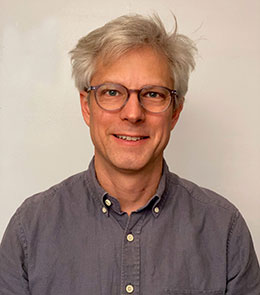
Brian Floca is the author and illustrator of Island Storm, Locomotive, Moonshot: The Flight of Apollo 11, Lightship, and other picture books. He is the author of Island Storm, illustrated by Sydney Smith, and is the illustrator of Avi’s Poppy Stories series. Brian’s books have received the Caldecott Medal, four Robert F. Sibert Honor awards for distinguished informational books, a silver medal from the Society of Illustrators, and have been selected three times for the annual New York Times Best Illustrated Books list. Brian was born and raised in Temple, Texas, and now lives and works in Brooklyn, New York.
1 thought on “2026 Summer Blog Series: Brian Floca”
Wow! In a nutshell (another metaphor) Brian Floca describes the role
of a creative! It’s not easy. Somehow, his essay relieves me of my anxiety.