
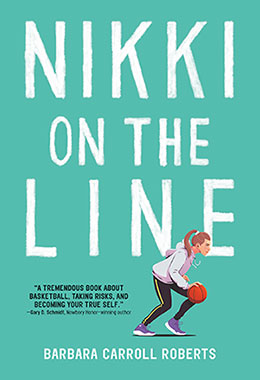
 Here’s an example of what I mean. After my first novel, Nikki On the Line, was published, many people said things like, “Wow, you know so much about basketball! Your scenes of games and practice are so vivid.”
Now the truth is, I knew very little about basketball when I decided to write this book, but I was spending many hours inside gyms, watching our daughter’s teams play, and I wanted to write a book for and about these girls. Girls who love basketball. But I also realized that if I didn’t get things right, if I used the wrong terminology, if my descriptions weren’t accurate, those girls would hate the book. They’d know that I didn’t know what I was writing about.
So I started to pay attention. Really pay attention. And I took notes. The warm-ups and drills coaches ran during practice. The exact way a coach showed our daughter to hold her hand to develop good shooting form. The way the ball spun as it came off her hand. The smells and sounds in different gyms. The specific aches and pains and floor burns common to basketball players.
And I listened. I listened to the girls’ conversations before, during, and after practices and games. I listened to what coaches said to the girls and to one another. I listened to officials. I scooted along bleacher benches to sit close to groups of parents so I could overhear their conversations. (And yes, I know all this counts as eavesdropping, which we all know is very rude. But we are writers, and in the interest of getting things right, we’re allowed to break this rule.)
I carried a notebook and I wrote down all the things I saw and heard and smelled. And all those things helped me create characters and scenes that felt authentic and real.
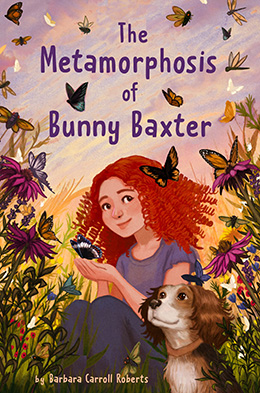 One other quick example. In my recent novel, The Metamorphosis of Bunny Baxter, about a girl who’s fascinated by insects, Bunny picks up dead cicadas in her yard and brings them inside to study under her magnifying glass. Which meant that I had to pick up dead cicadas in my yard and bring them inside to study under my magnifying glass. Which led to my husband and children saying things like, “Ewww, gross!” and, “Mo-om, you are so weird!” But I had to fully experience Bunny’s fascination in order to accurately reproduce it on the page. I had to look at insects through Bunny’s point of view. (Also, my family’s reactions gave me ideas about how other characters in my book would react to Bunny.)
Does this all sound like a lot of time-consuming work? Well, yes, it is. It’s also a lot of fun. And so interesting. When we pay close attention to what’s going on around us, we can learn so many wonderful things.
Which leads me to another piece of advice for young people from Richard Peck, author of many terrific children’s books including A Long Way from Chicago and A Year Down Yonder: “Had I known how brief childhood is, I’d have looked closer.”
Start right now! Engage with your world. What is that smell wafting from the deli at the end of your street every morning? Does the wind sound different blowing through the pines rather than the maple trees in the forest near your house? Is the chocolate cake your uncle made the best one you ever tasted? Or the worst?
Your world is individual and particular. What does it look like? How does it feel, sound, taste, and smell? Pay close attention. And take notes! Because you never know what you’ll need in the stories you’re going to write.
1 thought on “2026 Summer Blog Series: Barbara Carroll Roberts”
I wish more parents who have sat in gyms for countless hours would take notes and write books. Just sad your daughter didn’t wrestle! Great advice for young writers!