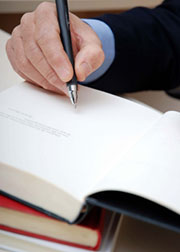
 I’ve done a fair bit of book signing over the years. In fact, I just did one this past weekend. I always enjoy these events, mostly because I get a chance to meet my readers, and chat with them. That said, when you sign books for a long period of time it can be—believe it or not—exhausting. I’ve known more than one writer—popular to be sure—who developed carpal tunnel syndrome from book signings.
At the risk of being absurd, let me suggest the physics of book signing.
First, the pen. It should be a rollerball ink pen. One wants to minimize the friction of pen to paper. The paper in books today, (hardback and paperback) is pretty cheap, rough stuff, and the flow of pen on paper can make an enormous difference. Never use quills.
The height of the signing table. It should not be table height, but typing table height, about 27 inches from the ground, so that the angle of the arm is down, never up.
The chair in which the author sits. The best is an adjustable one, (with a back rest!) so (see above) the arm angle is down. Stools are awful!
The name of the person you are signing to. These days you can never assume the spelling of someone’s name. Amy. Amee. Amie. Amé. And so forth. And if you ask a child his/her name they often (particularly if young) spell it out letter by letter in a very measured fashion, with an occasional glance at their guardian to check if it’s right. A bit of paper with the person’s name printed is a vast help. It also means you get the name right away and therefore can chat with the person.
The inscription. “To whom would you would you like me to inscribe the book?” I asked. “To the East Maplethrope Our Gracious Mother of God Middle School Fourth Grade Reading Group and their Beloved Teacher Mrs. Edna Nerobnicky.” I kid you not.
The photo op. With the ubiquitous cell phone—with camera—“Can I have a picture with you?” is a very common request. Here, a volunteer IT person standing by your side is a great advantage. But, if that volunteer stands too close, your reader, often out of shyness, talks to the volunteer, not the author. They need to be close, but not too close.
Finally, if you are doing an evening reading, let the kids come first, adults second.
2 thoughts on “The physics of book signing”
Books signings often seem like a free-flowing organic event but I can see how not paying attention to some of these details could make a signing session very uncomfortable for authors, especially if you are signing dozens or even hundreds of books. Over the years, I’ve come to appreciate the patience and kindness so many authors show whether there are three or three hundred people waiting for a book inscription. You are a special lot.
Thanks, Avi. It is good to know this type of things.
Anais