Avi’s Summer Blog Series 2026
Tracey Baptiste
From Avi: Just as we’ve done for the last four summers, 2025 through 2022, I’ve invited 13 admired authors to write for my blog throughout the summer. I hope you’ll tune in each Tuesday to see who answered this year’s question, which we hope provides you and the young people in your life with inspiration. Whether you already read these authors’ books or we’re introducing them to you, we trust you’ll find new books to read!
What advice can you give so I can become a writer?

Three Things Every Writer Needs
Stories are the way people have always communicated with each other. That means anybody can tell a story. But some people tell stories better than others because they’ve learned that good storytellers do three things:
- They check out other people’s stories and how they tell them. That’s education.
- They tell stories a lot. That’s practice.
- They pay attention to how other people respond to their stories. That’s feedback.
Nobody gets really good at telling stories without all three.
First, you need to experience a lot of stories. That might be listening to stories, watching movies and television, or reading. All of these are great ways to learn storytelling. But there’s a difference between listening, watching, and reading just to be entertained, and doing these things to learn how to be a better storyteller.
To learn, you need to pay attention to the details. Where does the story begin? Why do you think the storyteller starts there and not somewhere else? This will help you with your beginnings.
What places in the story surprised you? Why were you surprised? Was the surprise good or bad? Did the surprise change the story? This will help you with plotting.
Who is the story about? How about the other people in the story? How do they make it better or worse? This will help you with character development.
Most importantly, how does the story end? How did you feel about the ending? Ending a story is one of the most important things. A story can be awesome from beginning to middle and then end badly, and the audience will be unhappy. Audiences like a satisfying ending. By taking in a lot of stories, you’ll start to understand what makes a satisfying ending.
Let’s analyze a story together. I like doing Little Red Riding Hood with students. It starts when Little Red finds out that her grandmother is unwell and her mother packs a basket of food that will help Grandmother feel better. Why do you think the story starts there? Why not earlier? Why not later when Little Red is already on the way to Grandmother’s house?
Now let’s think about the characters in the story. Why is the story focused on Little Red and the wolf and not Little Red’s mom? What about the woodsman? Why isn’t he in the story until the end?
How about the plot? Were you surprised when the wolf ate Grandmother? How did it make you feel? How does this change the story?
When does the story end? How do you feel about the roles of Little Red, the wolf, Grandmother, and the woodsman after the story has concluded? Is it a satisfying ending for you? Would you change it?
This is how to pull apart a story to see what makes it work so you can learn skills for your own writing.
Now that you can analyze a story, you need to start practicing writing them. Remember to always write until you get to the end. A lot of writers slow down in the middle of a story because they are worried about making mistakes or they’ve changed their minds about the characters or plot as they write. That’s no reason to pause! Drafts will always have mistakes, and writers will always change parts of the story while they’re writing. That’s what the next draft is for. To fix these things!
Leave mistakes for later. As for changes … if you decide a character’s name, or the location of the story, or even the time period needs to be different, just keep writing as if you have already made that change. Maybe make yourself a note to remind yourself which changes need to be made, and where. On the next draft you’ll look at your notes and fix as you go. The important part is to get to the end.
Getting feedback will also help you figure out where the story is or isn’t working. Feedback from readers can be difficult. You might worry that they don’t like your work. But your job as the writer is to tell the best story that you can. If a story doesn’t communicate well, then you haven’t told the story the best way … yet. Pay more attention to how your reader feels about parts of the story than what they actually say about them. If there’s a part where they felt bored, maybe that part is too long. If there’s a part they didn’t understand, maybe you need to explain things more clearly. When readers tell you the parts they enjoyed, remember to do more of that!
Being a good writer doesn’t happen quickly. You will write and rewrite, get feedback and rewrite some more. Each time, you’ll become a better storyteller. In the end, there’s nothing like the amazing feeling that you’ve told a story in the best possible way. It’s worth the effort. I promise.
Particulars

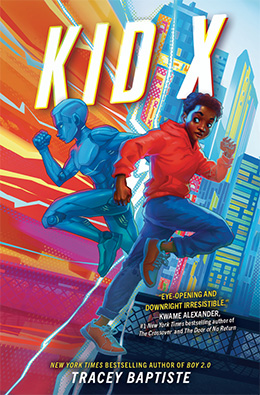
Tracey Baptiste is a New York Times bestselling author of twenty-six books for children including the popular Jumbies series including The Jumbies, Rise of the Jumbies, and The Jumbie God’s Revenge, as well as the picture book Looking for a Jumbie. She writes picture books, middle grade, and young adult, fiction and nonfiction, and has contributed to several anthologies. Her recent novels are Moko Magic: Carnival Chaos, Boy 2.0, and Kid X. Her nonfiction work, African Icons: Ten People Who Shaped History, is now available in paperback.