Headline:
“Last year, forty percent of Americans
did not read even one book.”
“You don’t have to burn books to destroy a culture.
Just get people to stop reading them.” —Ray Bradbury
In a time of cultural and political crisis, how should an artist respond? If you are Bruce Springsteen, you write a song called “Streets of Minneapolis,” an anti-ICE protest song, and it hits No. 1 on iTunes.
But if you write books for young people — books which take a few years to create — which is to say, an uncertain future — how do you go about your work?
I have a dislike of ideologies, all ideologies, because they more often than not provide you with automatic responses to whatever is happening. Having a siloed system of thinking means you are not thinking for yourself, but flipping through an index of answers, which you can peel off and slap onto any event. Do that and, in my view, you are abdicating in sharing your own emotions and thoughts.
When you write for young people, as I do, I think your responsibility is to create depth of character and situation so as to provide a glimpse of real life. It’s not because you are teaching young people, but because you are trying to expose them to the complexities of existence.
One of the key aspects of reading — and why I think the decline of reading is so alarming — is that reading helps to create greater empathy toward people and society. When you read, you absorb occurrences you would not — in your everyday life — deal with.
Reading fiction is a key way we learn how to experiment with people, places, and perplexity that we might otherwise never experience. When you are reading about experiences you might, in fact, confront, you gain even more. I’m not referencing stories that are composed in order to teach a moral lesson, but tales that have — as all good stories have — real dilemmas.
As a young reader once wrote to me, a good story “has a beginning, a muddle, and an end.” It is that muddle that is so crucial: how does one deal with it?

I am in the process of working out a new story — very much at the beginning — when the horrible immigration enforcement crisis — exploded in my face, and thoughts.
How do I — should I — incorporate my responses to those real events into the fiction I am creating? I have my own responses, and I am appalled by what is happening. But the story I am trying to write has nothing to do with the situation. Do I incorporate my feelings about the current situation into this tale?
I think the answer has to be that I must create a story that is deeply human, that is, filled with all of life’s complexity that I can set down on the page. I must not compose easy answers. I don’t want to teach; I want to share a piece of life, so the reader can engage with it.
Thus, to answer my question, do I incorporate my feelings about the current situation into this tale? My answer is no, realizing (and trusting) as I do that my response will still inevitably be embedded somewhere — however slight — into my writing. That is what I try to write about: the muddle.
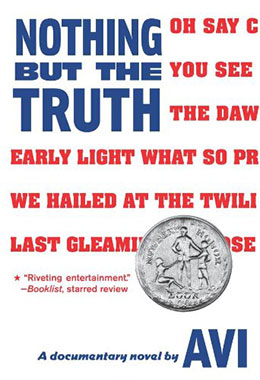
On the first page of my book, Nothing but the Truth, you will find this:
“Two Questions.
“Do you swear to tell the truth, the whole truth, and nothing but the truth?
“Does anyone say no?”
It’s the muddle about which I always want to write.
2 thoughts on “In Praise of Muddles”
Another of your blogs I will read over and over again. You nailed it in the value of writing for young people: the complexity of life choices in stories. It’s not to teach, but for the reader to explore and the writer to offer as much clarity as possible. Thank you, Avi. Edie
My seventh-grade students just finished reading Nothing But The Truth, and they loved it. As we read, we explored the question of what can blur the lines between what’s real and what’s not. They were surprised by how such an “old” book (LOL!) can be so relevant today. We have had so many great discussions during our reading. Thank you for this book, and thank you for this blog post.